What is Precision Agriculture? A Beginner’s Guide to Smart Farming
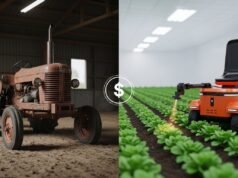
Agriculture is currently undergoing its most significant revolution since the invention of the tractor. For thousands of years, farming was an art form based on intuition, tradition, and a keen eye for nature. Farmers treated their fields as single, uniform units. If the corn looked pale, the entire field got fertilizer. If it was dry, the whole field got water.
However, as profit margins tighten and the global population surges, this “one-size-fits-all” approach is no longer sustainable. Enter Precision Agriculture.
This concept is reshaping how we grow food, turning farming from an art into an exact science. But what exactly is it? Is it only for mega-corporations, or can small family farms benefit too? This guide covers the basics of smart farming, the technology involved, and how to get started.
Defining the Concept: What is Precision Agriculture?
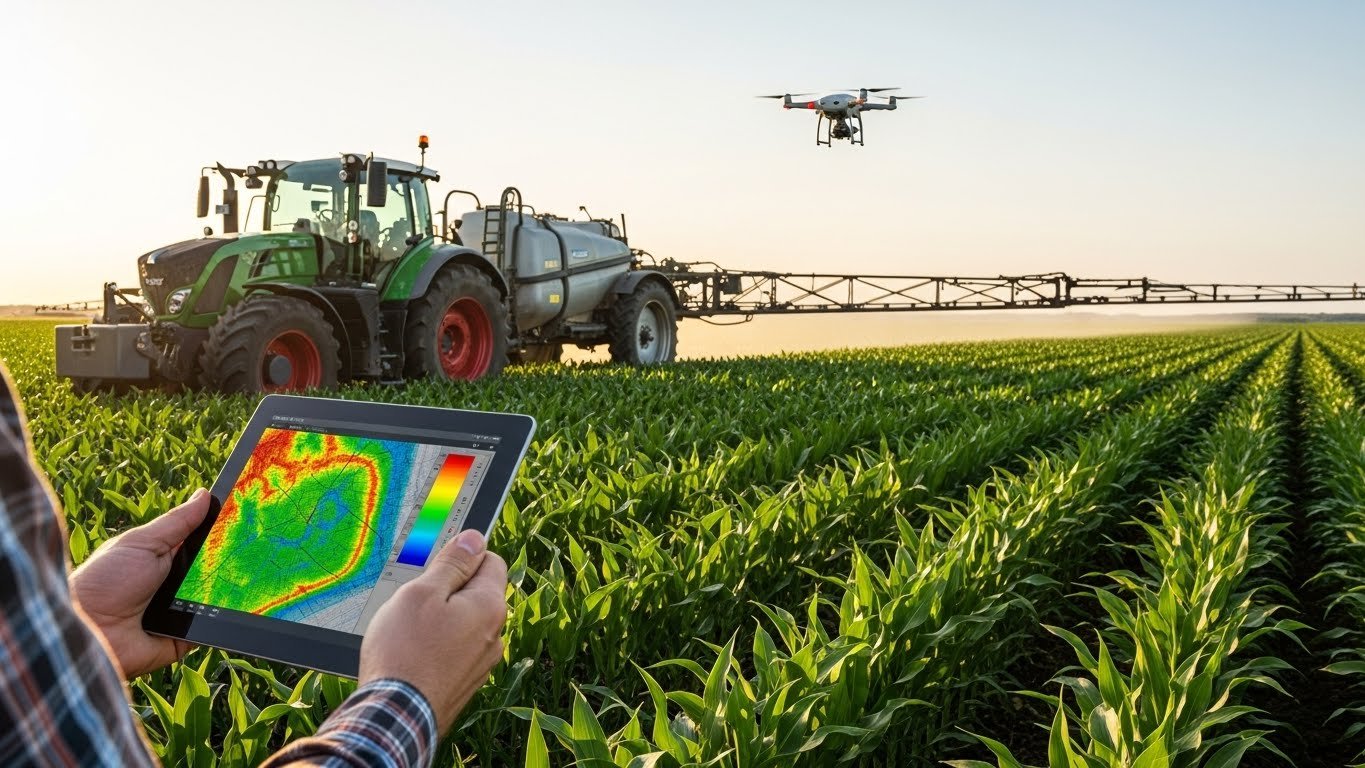
Precision Agriculture (PA), often called “smart farming” or “site-specific crop management,” is a farm management strategy that uses information technology to ensure that crops and soil receive exactly what they need for optimum health and productivity.
The goal is simple: The Right Input, at the Right Time, in the Right Amount, at the Right Place.
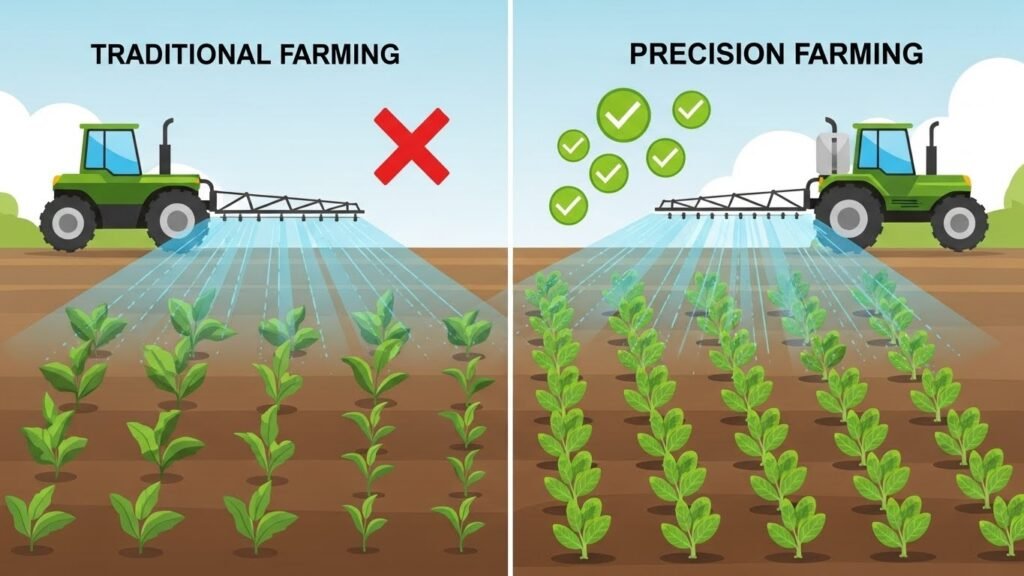
In traditional farming, you might spray 100 acres with the same amount of herbicide. In precision agriculture, technology helps you identify that only 5 acres actually have weeds. You then spray only those 5 acres. The result? You save money on chemicals, and the environment suffers less pollution.
The 4 Pillars of Precision Technology
You do not need a degree in computer science to understand the tools behind smart farming. While the algorithms are complex, the applications are designed to be user-friendly. Here are the four core technologies that make it work.
1. Global Positioning System (GPS)
It all starts with location. Just as the GPS in your car tells you where you are on the road, agricultural GPS tells a tractor exactly where it is in the field—down to the centimeter. This allows for “autosteer” systems, where the tractor drives itself in perfectly straight lines.
- Benefit: This eliminates overlap (spraying the same ground twice) and skips (missing a spot), saving up to 15% on fuel and material costs immediately.
2. Sensors and IoT (Internet of Things)
If GPS is the map, sensors are the eyes.
- Soil Sensors: These are probes inserted into the ground to measure soil moisture, temperature, and nutrient levels (Nitrogen, Phosphorus, Potassium).
- Crop Sensors: Mounted on equipment, these sensors scan plants as the tractor moves. They measure light reflectance (NDVI) to determine how much chlorophyll is in the plant, which indicates its health and nitrogen needs.
3. Remote Sensing (Drones and Satellites)
Sometimes, the best view is from above.
- Satellites: Provide large-scale imagery showing crop changes over weeks or months.
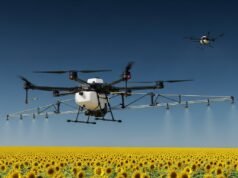
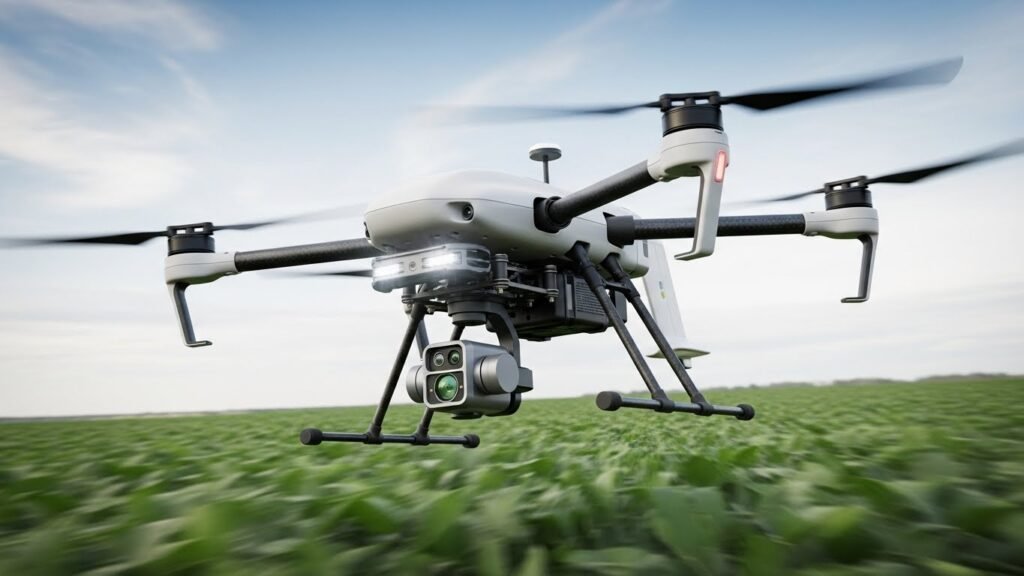
- Drones (UAVs): Agricultural drones can fly over a field in minutes, capturing high-resolution thermal or multispectral images. They can spot irrigation leaks, pest infestations, or fungal diseases days before they are visible to the human eye.
4. Variable Rate Technology (VRT)
This is where the action happens. VRT allows farm machinery to adjust the application rate on the fly.
- How it works: You load a digital prescription map into the tractor’s computer. As the tractor drives across the field, the VRT system automatically tells the sprayer or seeder to speed up or slow down the flow based on the map. One area might get 50 lbs of fertilizer, while a rich area ten yards away gets zero.
Why Should Farmers Adopt Precision Agriculture?
Change is difficult, and new equipment is expensive. So, why are farmers worldwide making the switch? The benefits generally fall into three categories: Economic, Agronomic, and Environmental.
Economic Benefits: Saving Money
Farming operates on razor-thin margins. The primary driver for precision agriculture is the Return on Investment (ROI).
- Input Reduction: By applying chemicals only where needed, farmers drastically reduce their fertilizer, herbicide, and pesticide bills.
- Fuel Efficiency: Optimized driving paths mean less time idling and fewer passes over the field.
- Labor Savings: Autosteer and automated systems reduce operator fatigue, allowing farmers to work longer hours during critical planting windows without making mistakes.
Agronomic Benefits: Better Yields
When a plant gets exactly the nutrients and water it needs, it grows better. Uniform fields make harvesting easier and processing more efficient. By identifying stress early (via drones or sensors), farmers can save a crop that might otherwise have been lost to disease.
Environmental Benefits: Sustainability
Consumers and governments are demanding sustainable food practices.
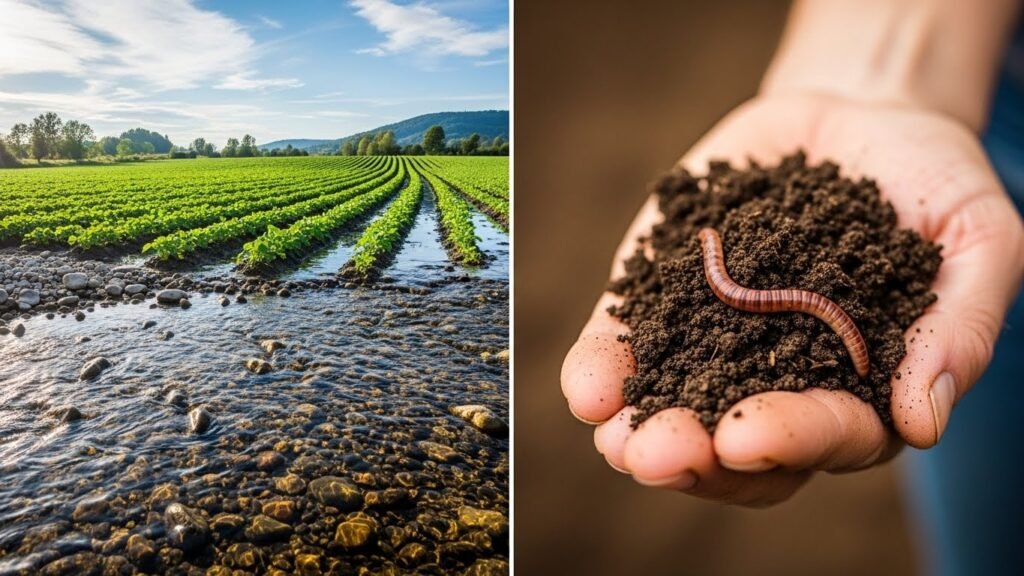
- Reduced Runoff: Nitrogen runoff is a significant pollutant. Precision application ensures the plant absorbs the chemical, rather than it washing away into local rivers.
- Water Conservation: “Precision Irrigation” ensures water is delivered only to dry areas, preserving local aquifers.
Real-World Examples
To visualize this, let’s look at two scenarios:
Scenario A: The Corn Farmer
A farmer in Iowa has a field with a sandy hill in the middle and heavy clay soil at the bottom.
- Old Way: Plant 30,000 seeds per acre everywhere. The sandy hill dries out, and the corn dies. The clay bottom gets overcrowded.
- Precision Way: The planter uses VRT. It drops only 24,000 seeds on the sandy hill (giving them more room to find water) and 34,000 seeds in the rich clay. The result is a higher overall yield at harvest.
Scenario B: The Vineyard Owner
A grape grower relies on irrigation.
- Old Way: Turn on the sprinklers for 4 hours every Tuesday.
- Precision Way: Soil moisture sensors alert the grower’s phone that the soil is still wet from a recent shower. The system cancels the scheduled irrigation. This saves thousands of gallons of water and prevents root rot.
Common Challenges to Adoption
It is essential to be realistic. Precision agriculture is not a magic wand, and it comes with hurdles.
- High Initial Cost: Smart tractors, drones, and software subscriptions require capital. However, retrofitting older equipment is becoming a popular, cost-effective alternative.
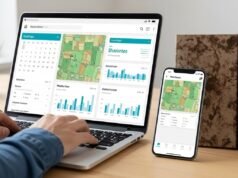
- Data Overload: A farm can generate terabytes of data. The challenge is not collecting data, but interpreting it. Farmers often need to work with agronomists or “Farm Management Software” (FMS) to turn numbers into decisions.
- Connectivity: Many rural areas lack high-speed internet. This makes cloud-based systems difficult to use. Fortunately, new satellite and LPWAN (Low-Power Wide-Area Network) technologies are addressing this by connecting devices even in remote locations.
How to Get Started
If you are a beginner, do not try to buy everything at once. Start small.
- Map Your Fields: Start by creating accurate digital boundaries of your farm.
- Analyze Your Soil: Invest in grid soil sampling. This is the most affordable entry point and offers immediate insights into your soil’s pH and nutrient levels.
- Monitor Yields: If you have a combine harvester, use a yield monitor to see which parts of your field are making money and which are losing money.
- Adopt Simple Tech: Buy a basic soil moisture sensor or a weather station. Learn to make decisions based on that data before investing in automated machinery.
Conclusion
Precision agriculture is the future of farming. It bridges the gap between the wisdom of traditional agriculture and the efficiency of the digital age.
For the modern farmer, it offers a path to profitability in a challenging economy. For the world, it provides a way to feed a growing population without destroying the planet. Whether you manage a small organic plot or a massive industrial operation, the tools to farm smarter are now within your reach. The transition may take time, but the harvest—both financial and environmental—is well worth the effort.