IoT in Agriculture: How Smart Sensors Are Saving Water and Money
Water is the lifeblood of agriculture. For centuries, the rule of thumb was simple: if the ground looks dry, add water. However, in today’s world, where water scarcity is a growing global crisis and energy costs for pumping are skyrocketing, “guessing” is no longer an affordable strategy.
This is where the Internet of Things (IoT) in agriculture comes into play. It promises a revolution not just in how we grow food, but in how we manage our most precious resources.
By connecting physical assets—like crops, soil, and irrigation pumps—to the internet, farmers can now “listen” to their fields. But how does it actually work? Is it complicated to set up? And most importantly, does it actually save money? This guide explores the practical applications of IoT sensors in farming and how they are transforming the industry.
What is IoT in Agriculture?
The “Internet of Things” sounds like a complex buzzword, but the concept is quite simple. It refers to a network of physical objects (“things”) embedded with sensors, software, and other technologies that connect and exchange data with other devices and systems over the internet.
In a home context, IoT is your smart thermostat adjusting the temperature when you leave the house. In an agricultural context, IoT is a soil probe that tells your irrigation system to turn off because it rained last night.
It transforms a farm from a collection of isolated elements into a connected, intelligent ecosystem.
The Problem: The High Cost of Over-Watering
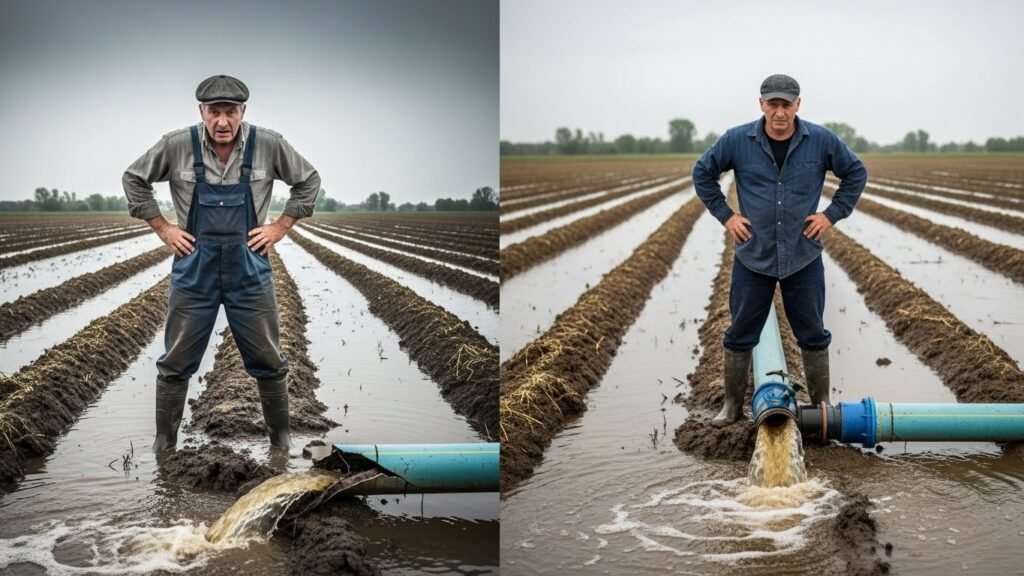
Before looking at the solution, we must understand the problem. Traditional irrigation is often inefficient. Farmers typically water on a schedule (e.g., every Monday and Thursday) or based on visual inspection.
Visual inspection is flawed because by the time a plant looks wilted, it is already stressed and losing yield potential. Conversely, the soil surface might look dry, but the root zone—where it matters—might be saturated.
Over-watering leads to:
- Wasted Water: Depleting local aquifers and reservoirs.
- High Energy Bills: Running electric or diesel pumps costs a fortune.
- Nutrient Leaching: Excess water washes away expensive fertilizers before the plant can use them.
- Crop Disease: Root rot and fungal diseases thrive in overly wet conditions.
The Solution: Smart Soil Sensors
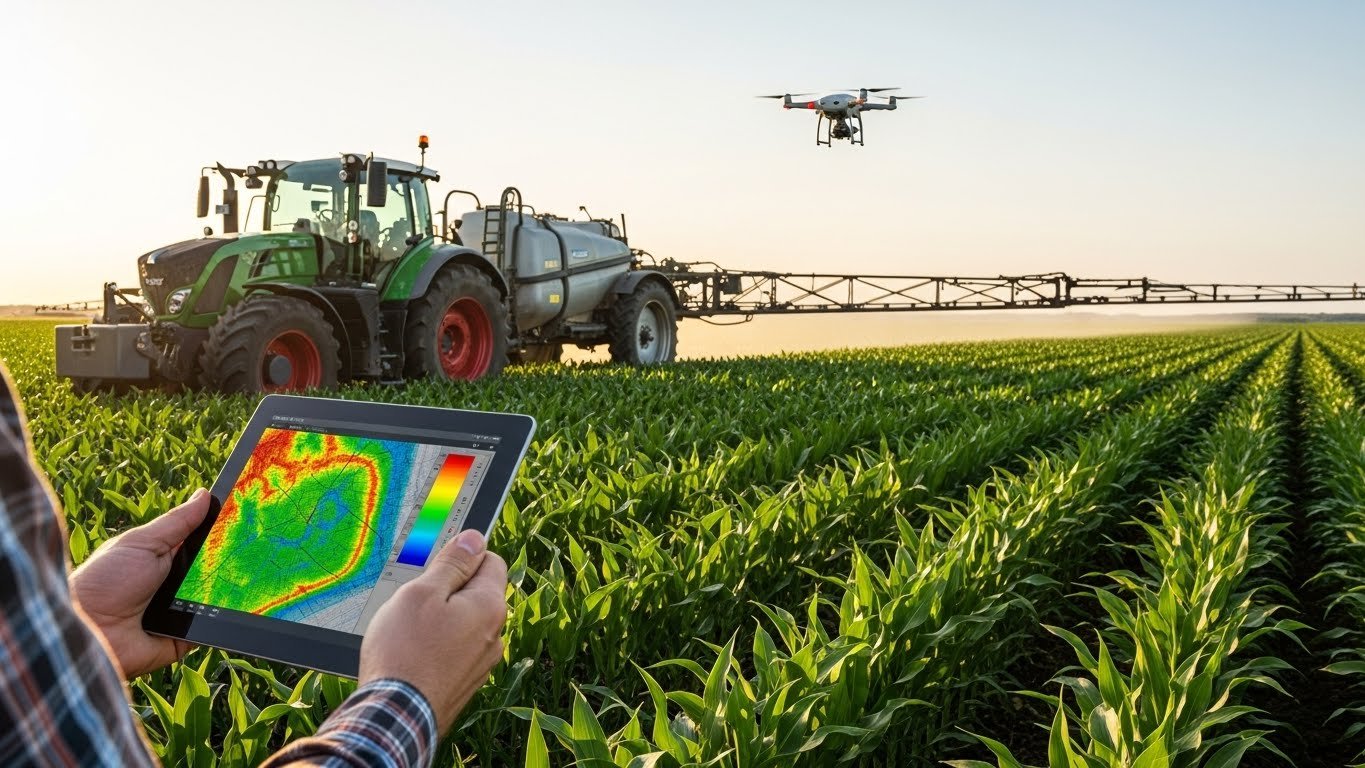
The most impactful application of IoT in agriculture today is soil moisture monitoring. These are not just “wet or dry” indicators; they are precision instruments.
How They Work
Modern IoT soil sensors measure “Volumetric Water Content” (VWC) at multiple depths (e.g., 6, 12, and 24 inches underground). They transmit this data wirelessly to the cloud.
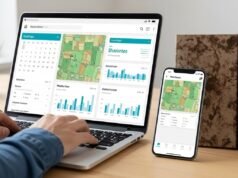
The farmer opens an app on their phone and sees a graph.
- Green Zone: Perfect moisture.
- Red Zone: Too dry (stress imminent).
- Blue Zone: Too wet (saturation).
The “Set It and Forget It” Approach
Advanced systems take this a step further. They integrate with the irrigation controllers. If the sensor reads 25% moisture, it sends a command to the pump: “Turn on.” Once it hits 35%, it sends a command: “Turn off.” This happens automatically, 24/7, without the farmer needing to drive to the field.
Beyond Soil: Other Critical IoT Sensors
While water is the primary focus, the IoT ecosystem in agriculture includes a variety of sensors that protect the bottom line.
1. Leaf Wetness Sensors
Fungal diseases like powdery mildew or blight need moisture on the leaves to reproduce. Leaf wetness sensors detect exactly how long a leaf has been wet. When the duration crosses a danger threshold, the system alerts the farmer to spray fungicide. This allows for preventative spraying rather than reactive spraying, saving the crop.
2. Micro-Climate Weather Stations
Regional weather forecasts are often inaccurate for specific fields. A farm might be 10 miles away from the nearest town’s weather station. On-farm IoT weather stations measure localized rainfall, wind speed, and humidity. This prevents farmers from watering right before a rainstorm.
3. Equipment Monitoring
IoT isn’t just for nature; it’s for machines too. Sensors on tractors and pumps monitor engine temperature, vibration, and fuel levels. They can predict a breakdown before it happens (predictive maintenance), saving days of downtime during critical harvest periods.
The Connectivity Challenge: How Do They Talk?
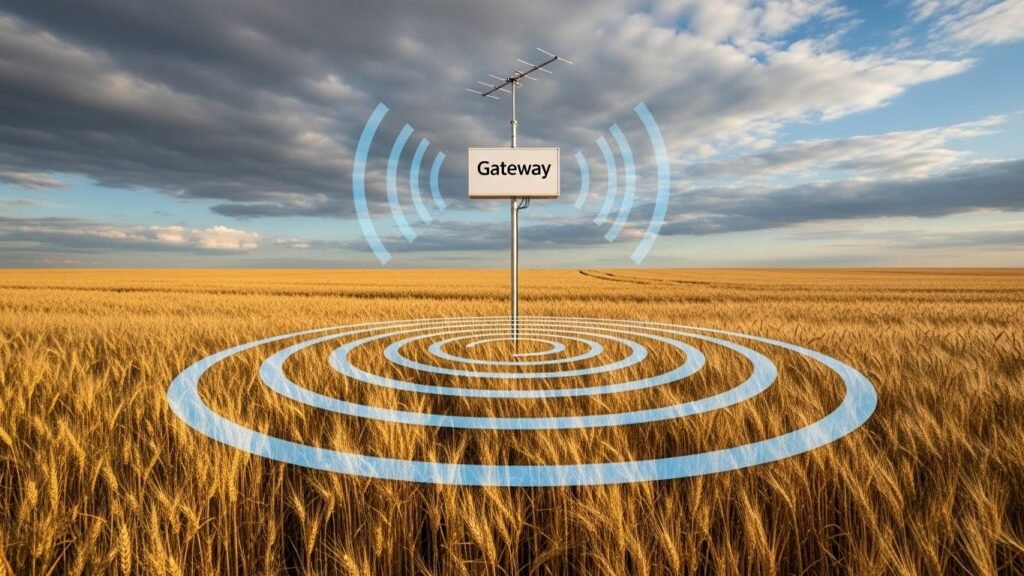
One of the biggest questions farmers ask is: “I don’t have Wi-Fi in the middle of my 50-acre cornfield. How does this work?”
This used to be a significant barrier, but new technologies have solved it.
- LoRaWAN (Long Range Wide Area Network): The gold standard for IoT in agriculture. It uses low-frequency radio waves to send small packets of data over very long distances (up to 10 miles) using very little battery power. A sensor can run for years on a single battery.
- Cellular (NB-IoT / CAT-M1): These use existing cell towers but on a low-bandwidth channel designed for sensors.
- Satellite: For extremely remote areas, sensors can beam data directly to low-orbit satellites.
Real-World ROI: Does It Save Money?
Let’s look at the economics. Installing a network of sensors represents an upfront capital expenditure. Is it worth it?
Case Study: The Vineyard
A vineyard in California installed soil moisture probes across 100 acres. Previously, they watered for 12 hours per block per week.
- Data Insight: The probes revealed that the clay soil held water much longer than expected.
- Action: They reduced watering to 8 hours a week.
- Result: A 33% reduction in water usage and pumping electricity. The system paid for itself in less than one growing season.
Case Study: The Potato Farm
Potatoes are susceptible to water stress. A farm in Idaho used IoT sensors to maintain consistent moisture.
- Result: Not only did they save water, but the “uniformity” of the potatoes improved. They had fewer small/misshapen tubers, which meant a higher percentage of the crop could be sold at premium market prices.
Challenges to Implementation
Despite the benefits, adoption is not automatic. There are hurdles to consider.
- Interoperability: There are many brands (John Deere, Trimble, myriad startups). Often, the soil sensor from Brand A doesn’t communicate with the irrigation pump from Brand B. As a result, farmers end up with 5 different apps on their phones. The industry is working toward standardization (like ISO XML), but it is a work in progress.
- Data Security: Farm data is valuable. Farmers need to ensure that the cloud platforms they use are secure and that they retain ownership of their agronomic data.
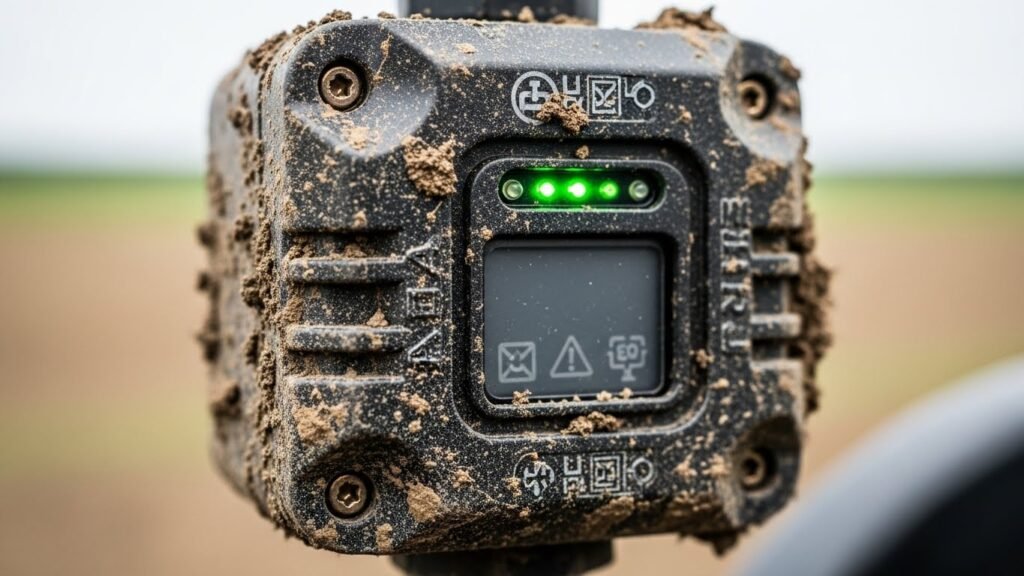
- Durability: Farming is harsh. Sensors must withstand UV radiation, rain, mud, freezing temperatures, and heavy machinery running over them. Cheap sensors often fail within a season.
The Future: AI and Automation
We are currently moving from “monitoring” to “automation.”
- Now: The sensor tells you the soil is dry. You turn on the pump.
- Next Year: The sensor tells the pump the soil is dry. The pump checks the weather forecast (AI) to see if rain is coming. If no rain is predicted, the pump turns itself on.
Artificial Intelligence (AI) will analyze historical data from IoT devices to predict crop yields and suggest precise fertilizer plans, eliminating human error.
Conclusion
The adoption of IoT in agriculture is no longer a futuristic luxury; it is becoming a necessity for survival in a competitive market. By replacing guesswork with complex data, farmers can significantly reduce input costs while increasing yields.
Water is becoming more expensive and more complicated to access. The farmers who learn to manage it with precision today are the ones who will thrive tomorrow. Whether you start with a single weather station or a fully automated irrigation network, the key is to start listening to what your field is trying to tell you.